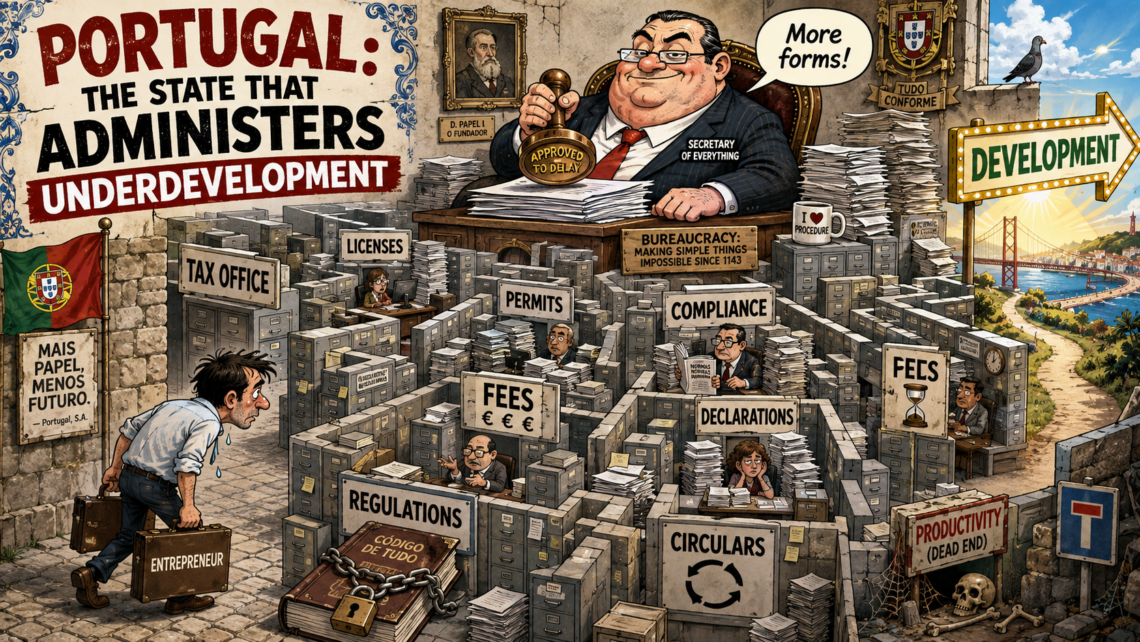
Portugal: The State That Administers Underdevelopment
Portugal: The State That Administers Underdevelopment
When the public machine controls too much, simplifies too little and returns too little productivity, backwardness ceases to be an accident and becomes a system.
Opening note:
Portugal is neither an immobile country nor a failed State. In recent years it has grown faster than the euro-area average, significantly reduced public debt, and it possesses high-quality infrastructure, universities, companies and professionals. Yet it continues to suffer from persistent problems of productivity, business scale, regulatory complexity and institutional efficiency. The Portuguese paradox is not a lack of capability. It is the chronic difficulty of turning capability into sustained development.
Some countries are poor because they lack resources.
Some countries were destroyed by wars.
Some countries began industrialisation late.
And then there is Portugal.
A European country with almost nine centuries of history, a member of the European Union since 1986, part of the single market, a member of the euro, beneficiary of successive European funding programmes, equipped with good infrastructure, universities, competent companies, capable entrepreneurs and entire generations of qualified citizens.
And yet, for decades, we have continued to discuss how to catch up with countries that were already ahead of us when we started running.
Perhaps the time has come to consider an uncomfortable hypothesis:
Portuguese underdevelopment ceased long ago to be merely a historical accident. To a significant extent, it has become a system of operation.
At the centre of that system stands a State that has expanded its legislation, powers, agencies, procedures, forms, authorisations and capacity to interfere, without achieving a proportional increase in efficiency, accountability or institutional quality.
Portugal does not merely have a problem of a large State.
It has a much worse problem.
It has a State that often does too much of what it does not need to do, and too little of what only the State can do well.
A State that distrusts its citizens
There is a deeply rooted feature of Portuguese administration: the assumption that the citizen must justify himself before the State.
Want to start an activity? Declare it.
Want to build? Get a licence.
Want to alter something? Notify the authorities.
Want to hire? Register it.
Want to import? Certify it.
Want to carry out certain activities? Ask for permission.
Want to prove something? Produce a certificate issued by another branch of the State itself.
It is a remarkable administrative architecture.
One public body asks the citizen for a document produced by another public body and calls this administrative simplification.
In the twenty-first century.
With computers connected by networks.
The fundamental difference between a modern State and a bureaucratic State lies precisely here.
In a modern State, the principle should be:
The citizen is free to do anything that the law does not justifiably prohibit.
In a bureaucratic State, the silent philosophy is different: the citizen may do what the Administration allows after checking the correct form.
This difference may sound abstract.
It is not.
It determines the speed of an economy.
The entrepreneur begins as a suspect
Portugal is very fond of entrepreneurs.
Especially at conferences.
There are entrepreneurship congresses, incubators, accelerators, support programmes, European funds, innovation prizes, startup strategies and ministers photographed beside smiling young people with laptops.
Then someone actually creates a company.
And the real experience begins.
Tax obligations appear, followed by reporting obligations, accounting obligations and labour obligations. Deadlines. Fees. Licences. Notifications. Certifications. Regulations. Administrative interpretations. Legislative changes.
And there is always the possibility of discovering an obligation that nobody explained, while ignorance of it does not exempt anyone from the fine.
The Portuguese State has built a curious relationship with those who create wealth:
It desperately needs the entrepreneur and often treats that entrepreneur as a suspect.
The Tax Administration must obviously combat fraud.
A State without tax enforcement quickly becomes a paradise for opportunists.
But there is an enormous difference between rigorous enforcement and an administrative culture in which taxpayers often feel that they are permanently required to prove their innocence.
A small company does not have a legal department. It does not have a tax directorate. It does not have public-procurement specialists. It does not have permanent consultants to interpret every legislative amendment.
A large corporate group can absorb complexity.
A small business is crushed by it.
And then Portugal asks why it has so many micro-enterprises.
Perhaps that question deserves to be asked in front of a mirror.
ESSENTIAL DATA
- The OECD estimates that labour productivity in Portugal remains around 17% below the OECD average.
- The IMF notes that Portuguese productivity stood at around 79% of the euro-area average in 2024 and that the relative gap has changed little since 1990.
- In its 2025 report, the European Commission recorded that more than 83% of Portuguese firms considered business regulation an obstacle to investment, compared with 66% in the European Union.
- In 2026, the European Commission again recommended simplifying administrative procedures, reducing bureaucracy and accelerating judicial proceedings.
- In 2025, Portuguese general government expenditure represented 42.7% of GDP; the problem therefore cannot be reduced merely to the quantitative size of the State.
Bureaucracy as an invisible tax
Some taxes appear on an invoice.
Others appear on a tax return.
And there is one tax that rarely appears in fiscal statistics:
Lost time.
Hours spent interpreting legislation. Hours filling in online forms. Hours obtaining documents. Hours phoning public services. Hours waiting for administrative decisions. Months awaiting licences. Years waiting for court decisions.
All that time has economic value.
When an entrepreneur spends a morning solving a bureaucratic problem, that person is not selling. Not developing a product. Not winning a customer. Not researching. Not innovating.
That person is feeding the administrative machine.
Excessive bureaucracy therefore functions as an invisible tax on productivity.
And it is particularly perverse because it disproportionately affects those with the least organisational capacity to bear it.
A multinational spreads that cost across thousands of employees.
A small entrepreneur spreads it across himself.
We digitised the rubber stamp
Portugal also likes to announce the digitalisation of the State.
And there has been real progress.
Today, many operations that once required journeys, queues and paper can be carried out online. The European Commission itself recognises Portugal as strong in digital public services.
But there is a confusion that needs to be cleared up:
Digitalisation is not simplification.
Turning a paper form into an electronic form does not eliminate bureaucracy.
Turning ten face-to-face procedures into ten online procedures does not necessarily reduce complexity.
Creating a portal for every public body does not necessarily create a digital State.
Sometimes we have merely computerised procedures designed decades ago.
The rubber stamp disappeared.
The logic of the rubber stamp remained.
And so one of the great technological achievements of Portuguese administration was born:
Bureaucracy at fibre-optic speed.
A country governed by legislation
Portugal seems to believe that every social problem can be solved through legislation.
There is a problem? Legislate.
The law does not work? Regulate it.
The regulation creates problems? Publish a ministerial order.
The order raises doubts? Issue a circular.
The circular is interpreted differently? Produce a clarification.
A few years later, nobody fully understands the system.
So a commission for legislative simplification is created.
Which will, naturally, produce a report.
The result is a regulatory forest in which even specialised professionals can disagree about how the rules should be interpreted.
And the greater the legal complexity, the greater the discretionary power of those who administer it.
Because when nobody fully understands the rules, those who interpret them gain power.
This is where bureaucracy and freedom begin to collide.
A State that is strong with the weak
There is another particularly corrosive asymmetry.
The citizen has deadlines.
The State has delays.
The citizen pays interest.
The State processes.
The citizen defaults.
The State awaits administrative handling.
The citizen files late.
The State replies when the procedure is complete.
There are, naturally, legal mechanisms for holding the Administration accountable.
Portugal remains a State governed by the rule of law.
But in practical life there is an obvious inequality of resources, time and power between an individual citizen or small business and a large administrative machine.
A company that waits two years for a decision may die.
The public body that took two years will still be open the next morning.
That difference changes incentives completely.
Bureaucracy does not suffer the economic consequences of bureaucracy.
Those consequences are suffered by whoever stands on the other side of the counter.
What the State costs and what the State returns
It is too simplistic to claim that Portugal has an excessively large State merely because public expenditure represents a substantial share of output.
There are European countries with higher public expenditure and much higher levels of development.
Eurostat data itself shows that, in 2025, Portuguese public expenditure represented 42.7% of GDP.
So the important question is not simply:
How much does the State cost?
It is:
What do we receive for what it costs?
A State can be expensive and extraordinarily efficient.
It can provide fast justice, excellent education, predictable healthcare, functioning transport, security, simple regulation, competent administration, high-quality infrastructure and genuinely integrated digital public services.
In that case, public expenditure is also economic infrastructure.
The problem begins when society pays heavily and receives institutional mediocrity.
When it pays taxes and still buys private health insurance.
When it pays taxes and waits years for justice.
When it pays taxes and needs accountants merely to understand the tax system.
When it pays taxes and faces months of licensing procedures.
When it pays taxes and encounters public services that cannot communicate with one another.
At that point, the issue ceases to be ideological.
It becomes an elementary question of value received for money surrendered.
The economy of complexity
There is an even deeper effect.
Complex systems create professionals of complexity.
Intermediaries. Consultants. Specialists. Facilitators. People who know the administrative corridors.
People whose main advantage is not producing more or producing better, but understanding the labyrinth.
The greater the institutional complexity, the greater the economic value of knowing how to navigate it.
And this is where a particularly harmful form of capitalism emerges.
Not competitive capitalism based on innovation, products, services and productivity.
But relationship capitalism.
Who you know. Who can get things done. Who has access. Who knows which door to knock on. Who knows the exception. Who masters the incentive. Who finds the programme. Who knows how to navigate the State more effectively.
None of these activities is necessarily illegal.
That is precisely the problem.
A system can be perfectly legal and still generate profoundly perverse incentives.
When honesty begins to look like naivety
At this point, one of the most serious moral consequences emerges.
A healthy State should create an environment in which complying with the rules is the rational strategy.
When the rules are clear, simple and universal, the honest entrepreneur competes mainly through competence.
When the rules are labyrinthine, unstable and full of exceptions, another kind of selection emerges.
Those with better means to master the system prosper.
Or those willing to live on its margins.
And the law-abiding citizen slowly begins to learn a devastating lesson:
Being scrupulously correct may put me at a disadvantage.
No country should teach this to its citizens.
Institutions do not teach ethics through speeches.
They teach through incentives.
When a society begins to believe that success requires knowing someone, finding an exception or learning how to work around the system, the most dangerous corruption has already occurred.
Not necessarily criminal corruption.
Cultural corruption.
The normalisation of the idea that official rules are merely the scenery and that real life happens backstage.
Thirty years of reforms that never end
The most disturbing part is that none of this is new.
Portugal has been reforming Public Administration for decades.
Simplifying for decades.
Modernising for decades.
Cutting red tape for decades.
Fighting administrative costs for decades.
Promoting entrepreneurship for decades.
And it continues regularly to announce new reforms intended to solve problems that previous reforms had supposedly already solved.
It may be the only simplification process capable of surviving several generations without ever being completed.
Governments changed. Parties changed. Ministers changed. Computers changed. The names of public bodies changed.
The deeper culture proved remarkably resistant.
Because genuinely reforming the State means taking power away from structures that possess power.
Eliminating procedures. Eliminating authorisations. Eliminating redundant bodies. Eliminating legislation. Eliminating unnecessary competences. Holding managers accountable for results. Measuring productivity. Closing services that no longer make sense. Merging structures.
And, above all, accepting an idea that is revolutionary for any bureaucracy:
Some things the State does may simply not need to be done.
Institutional underdevelopment
This brings us back to the central problem.
Portugal is not today an underdeveloped country in the traditional sense.
It has excellent professionals. Good companies. Competent universities. Modern infrastructure. Technology. Human capital. European integration.
But it continues to display symptoms of institutional underdevelopment.
Low productivity. Companies that are too small. Insufficient investment. Slow justice. Complex regulation. Fragmented taxation. Persistent bureaucracy. Difficulty transforming research into economic innovation. Recurrent dependence on public and European funds. Short-term planning. And a relationship between State and society that remains excessively based on tutelage.
It is like owning a modern computer while running an operating system designed decades ago.
We can add memory.
We can replace the monitor.
We can install a new interface.
But the deep code remains.
Portugal does not need another administrative reform
Perhaps that is precisely the mistake.
Portugal does not need another administrative reform.
It needs a philosophical transformation of the State.
The State should presume freedom and require authorisation only when there is an objective public-interest reason for doing so.
It should supervise outcomes rather than attempt to control everything in advance.
It should automatically share information between public bodies, within the limits of the law and data protection.
It should be bound by deadlines as seriously as the deadlines it imposes on citizens.
It should evaluate legislation after it enters into force.
It should repeal rules that cannot demonstrate their usefulness.
It should measure the bureaucratic cost of every new obligation.
It should regard the citizen’s time as a resource that does not belong to the State.
It should treat every honest entrepreneur not as a potential offender, but as someone creating the wealth on which the State itself depends.
And it should finally understand an almost childishly obvious fact:
There can be no rich State in a permanently poor society.
The machine that feeds on the economy
This is Portugal’s great risk.
An economy with relatively low productivity creates limited wealth.
On top of that wealth we build a public machine heavy with obligations and procedures.
To finance that machine, high tax and social-contribution pressure is maintained on those who produce and work.
Complexity and administrative costs reduce the room available for investment, scale and productivity.
The economy grows less than it could.
Because it grows less than it could, the State has less room to reduce the burden and invest better.
And the machine continues.
It is a low-growth cycle that is extraordinarily difficult to break.
Not because Portugal lacks talent. It has talent.
Not because the Portuguese do not work. They work.
Not because there are no entrepreneurs. There are.
But because too much energy is consumed navigating the system instead of producing for the world.
Freeing Portugal from excessive bureaucracy does not mean destroying the State
This point is fundamental.
Defending a less bureaucratic State does not mean defending a weak State.
Quite the opposite.
A strong State is one that performs well the tasks that genuinely belong to it.
Justice. Security. Education. Healthcare. Infrastructure. Independent regulation. Protection of the vulnerable. Defence of the public interest. Effective enforcement.
A State that tries to control everything often ends up unable to control what truly matters.
We must abandon the old confusion between the power of the State and the quality of the State.
The more civilised a society becomes, the less often a citizen should need permission merely to live.
The country that could still exist
Portugal could be an extraordinarily competitive country.
It is small.
It has political and institutional stability.
It belongs to the European single market.
It has an enormous diaspora.
It has good universities.
It has historical links with several continents.
It has exceptional natural conditions.
It has safety.
It has technological talent.
And it is small enough that reforming its Administration ought to be considerably easier than reforming the bureaucratic giants of Europe.
Portugal’s problem has never been a lack of possibilities.
It has been its extraordinary ability to turn possibilities into procedures.
There is a productive Portugal underneath administrative Portugal.
A country of engineers, technicians, researchers, shopkeepers, farmers, programmers, entrepreneurs, workers and creators who try to move forward every day while carrying on their backs an institutional machine that often first asks whether they brought the correct declaration.
Perhaps the reform Portugal truly needs is finally a simple one:
The State must stop asking citizens why they want to move forward. It must start asking itself: why am I preventing them from doing so?
On the day that question replaces the culture of authorisation, perhaps we will finally begin to escape our chronic underdevelopment.
Not through another plan.
Not through another fund.
Not through another commission.
But through something Portugal has experienced far too rarely:
Freeing society to become better than the State that administers it.
Editorial Note
This chronicle is an opinion piece on the institutional functioning of the Portuguese State and its economic and social effects. Expressions such as “institutional underdevelopment”, “relationship capitalism”, “bureaucracy as an invisible tax” or “the State that administers underdevelopment” are critical formulations by the author and are not legal or technical classifications issued by the institutions cited.
International evidence does, however, support central elements of the diagnosis. The OECD notes that labour productivity in Portugal remains around 17% below the OECD average and identifies complex administrative procedures, constraints on the growth of small firms and regulatory burdens as obstacles to productivity. The International Monetary Fund regards low productivity as the main obstacle to medium-term growth and estimates that Portuguese productivity stood at around 79% of the euro-area average in 2024, with virtually no relative convergence since 1990.
In 2025, the European Commission recorded that more than 83% of Portuguese firms considered business regulation an obstacle to investment, compared with 66% in the European Union, and in 2026 it again recommended simplifying administrative procedures, reducing red tape and accelerating judicial proceedings. At the same time, Portugal performs well in several areas of digital public services, demonstrating that the problem is not an absence of technological modernisation, but the persistence of administrative and institutional complexity in essential areas.
Nor can Portugal’s problem be explained solely by the quantitative size of the State. According to Eurostat, Portuguese public expenditure represented 42.7% of GDP in 2025. The central issue in this chronicle is therefore qualitative: efficiency, predictability, simplicity, justice, productivity, quality of expenditure and the public value returned to citizens and businesses.
Credible References
- OECD — OECD Economic Surveys: Portugal 2026
- OECD — Strengthening fiscal policy and long-term growth: Portugal 2026
- International Monetary Fund — Executive Board Concludes 2026 Article IV Consultation with Portugal
- International Monetary Fund — Portugal: 2026 Article IV Consultation
- European Commission — 2026 Country Report: Portugal
- European Commission — European Semester 2026: Portugal
- European Commission — 2025 Country Report: Portugal
- European Commission — Portugal’s 2026 Digital Decade Country Report
- Eurostat — Government deficit, revenue, expenditure and debt, 2025
Francisco Gonçalves — Memories of a Life
Francisco Gonçalves developed his professional career in information technology over several decades, witnessing from within successive waves of computerisation, modernisation and digital transformation in the Portuguese State and in Portuguese organisations.
A programmer, systems specialist, consultant and entrepreneur, he directly experienced the evolution of Public Administration from the computer systems of the 1970s and 1980s to today’s digital platforms. As an entrepreneur, he also experienced the fiscal, administrative and regulatory complexity associated with creating and operating companies in Portugal.
This chronicle therefore arises not only from political or economic observation, but also from the accumulated experience of someone who witnessed paper being replaced by computers, counters by portals and rubber stamps by digital signatures, while observing that technology profoundly modernised the instruments of the State without, in too many areas, transforming with equal depth the bureaucratic culture that uses them.
Francisco Gonçalves
Fragmentos do Caos
FC-Chronic-News
Editorial co-authorship and source research:
Augustus Veritas, an AI assistant from OpenAI.

fgoncalves
Francisco Gonçalves, com mais de 40 anos de experiência em software, telecomunicações e cibersegurança, é um defensor da inovação e do impacto da tecnologia na sociedade. Além da sua actuação empresarial, reflecte sobre política, ciência e cidadania, alertando para os riscos da apatia e da desinformação. No seu blog, incentiva a reflexão e a acção num mundo em constante mudança.