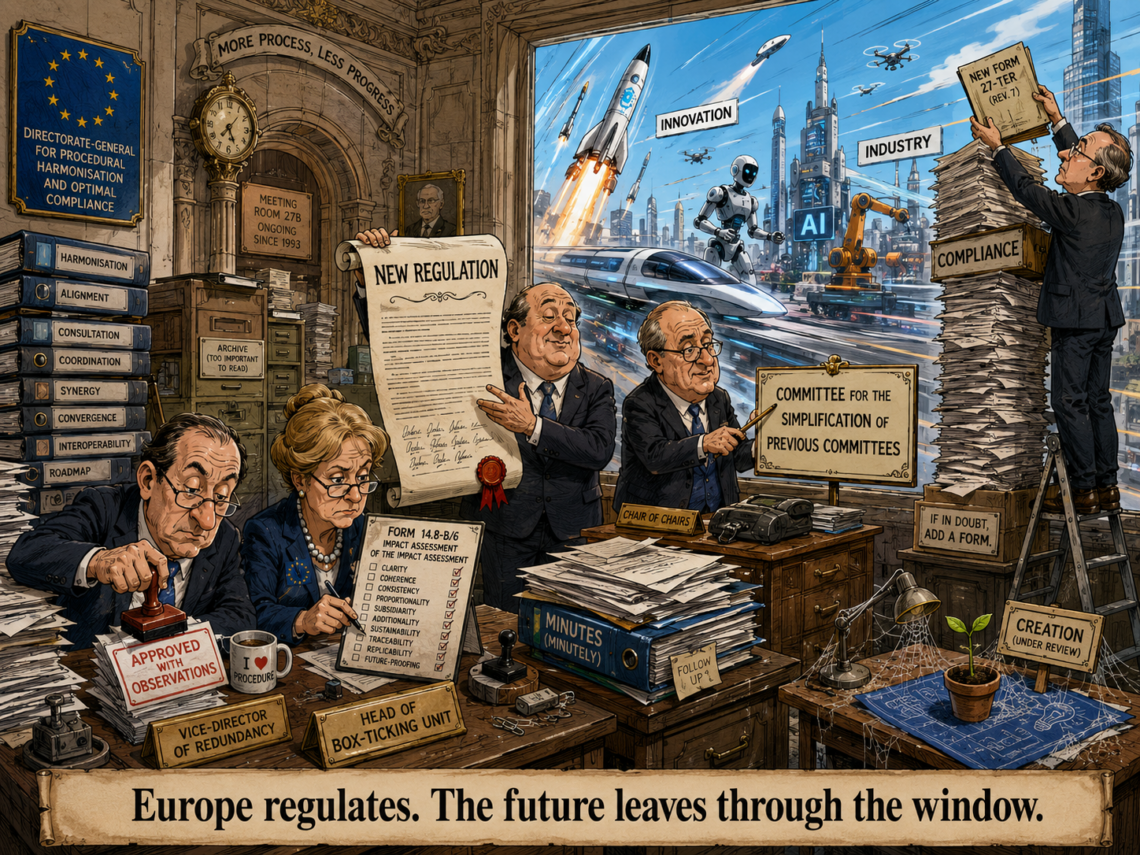
Europe of Forms: When a Continent Trades Ambition for Bureaucracy
FC Chronic News · Europe · Technology · Competitiveness
Europe of Forms: When a Continent Trades Ambition for Bureaucracy
A critical chronicle of a Europe that became exceptionally skilled at managing the present while losing the habit of building the future
There was a time when Europe invented the future. It built locomotives, engines, automobiles, aircraft, power stations, medicines, computers, telecommunications networks and some of the greatest scientific institutions in human history. It was a continent of engineers, physicists, mathematicians, industrialists, inventors and entrepreneurs.
Today, far too often, it seems to have discovered a new vocation:
regulating what others invent.
The United States builds digital platforms.
China builds factories.
Taiwan manufactures advanced semiconductors.
South Korea produces memory, displays and electronics.
Europe produces a directive explaining the conditions under which all of it may be used.
Is that a caricature? Naturally.
The uncomfortable part is how much reality the caricature contains.
The continent that began to fear itself
The European Union was born from an extraordinary idea. After centuries of wars, turning historical enemies into an economic and political community based on cooperation, trade, democracy and law was one of the greatest political achievements of the twentieth century.
But institutions age too. And when they age badly, they begin to confuse stability with immobility.
Europe gradually developed an administrative culture in which every problem appears to require a new rule, every risk a new authority, every exception a new procedure and every procedure an additional form.
Then comes the classic disease of large organisations:
the process becomes more important than the outcome.
A company wants to manufacture.
The administration asks whether the form has been completed.
A researcher wants to experiment.
Someone asks where the authorisation is.
A startup wants to grow.
It is asked for reports.
An industrial company wants to build a factory.
It discovers that before producing anything it must cross years of permits, assessments, consultations, opinions, certifications and appeals.
By the time it is finally authorised to manufacture, the American competitor may already be shipping the third generation of the product.
But everything will be perfectly documented.
Do we regulate because we no longer know how to lead?
Regulation is necessary. Civilised societies need to protect consumers, workers, privacy, the environment and fundamental rights.
The problem begins when regulation stops accompanying innovation and starts replacing it.
The European Union has become remarkably efficient at producing rules for sectors in which it possesses increasingly little global leadership.
In the digital revolution, the dominant operating systems are not European. The dominant search engines are not European. The largest clouds are not European. The largest social platforms are not European. The leading suppliers of GPUs for artificial intelligence are not European. And the most influential frontier AI systems have emerged largely from the United States and China.
Yet one of Europe’s most visible demonstrations of technological power was to create a comprehensive legal framework for artificial intelligence.
There is something almost philosophical about the situation.
We do not control much of the infrastructure.
We do not manufacture most of the critical processors.
We do not dominate the platforms.
We do not host most of the world’s leading private AI laboratories.
But we have the regulation.
It is rather like losing the global automobile industry and taking pride in having written the world’s finest highway code.
This does not mean that the EU AI Act is pointless. High-risk systems, medical applications, mass surveillance, automated discrimination and fundamental-rights questions require safeguards. But the strategic question is one of proportion, timing and institutional temperament. Even the Financial Times argued in late 2025 that the EU needed to rethink parts of its AI rules because excessive rigidity could damage European firms and startups while the United States and China continued to scale.
While others ask “how?”, we ask “is it permitted?”
There is a profound cultural difference between innovative societies and bureaucratised ones.
The entrepreneur asks: “What can I build with this?”
The engineer asks: “How can I make it work?”
The investor asks: “How large can it become?”
The bureaucracy asks: “Who authorised it?”
All four questions have legitimacy.
But a civilisation that permanently places the last question before the other three eventually buys technology from the civilisations that asked the first three first.
That is precisely where Europe appears to have become trapped.
We built a gigantic institutional machine designed to prevent anything from going wrong.
We forgot one possibility:
doing nothing can also go catastrophically wrong.
Not investing has consequences.
Not building has consequences.
Not experimenting has consequences.
Not taking calculated risks has consequences.
Losing strategic industries has consequences.
Becoming technologically dependent on other powers has consequences.
Bureaucracy measures the risks of action with admirable precision.
It is much less talented at measuring the risks of inaction.
The peculiar art of making life difficult for those who produce
Perhaps the greatest perversity is this: those who create wealth increasingly have to justify themselves before systems whose principal output is procedure.
European businesses must navigate tax rules, labour rules, environmental rules, corporate rules, data protection, sustainability requirements, certifications, declarations, statistics and reporting obligations accumulated layer upon layer like geological sediment.
Each individual rule may have a perfectly reasonable justification.
It is the sum that becomes unreasonable.
Bureaucracy has a fascinating property: nobody is responsible for the total bureaucracy.
Every department adds only one small obligation.
One more field.
One more declaration.
One more report.
One more portal.
One more password.
One more certificate.
One more regulation.
Nothing appears particularly serious until somebody actually tries to start and grow a company and discovers that entrepreneurship has somehow become an involuntary postgraduate degree in comparative public administration.
And the asymmetry is especially brutal for small companies.
A multinational hires legal departments, consultants, auditors and compliance specialists.
A ten-person company has the accountant.
When Brussels creates a fifty-page administrative obligation designed to improve the market, it may have created a modest inconvenience for a multinational.
For a small company it may have created the need for another non-productive employee.
Then Europe wonders why its companies struggle to scale.
A mystery worthy of CERN.
Bureaucracy has finally discovered bureaucracy
There is, however, an almost irresistible development.
The European Commission itself now explicitly acknowledges that administrative burdens are an obstacle to growth. By 2029 it aims to reduce those burdens by at least 25% for businesses overall and 35% for small and medium-sized enterprises, with expected savings of €37.5 billion. In June 2026, the Commission said that twelve omnibus simplification proposals and related measures already represented around €18 billion in annual administrative savings.
This is a remarkable revelation.
After decades spent building the labyrinth, the Minotaur has discovered that there may be too many corridors.
The Union is therefore creating legislative packages to simplify legislative packages previously created by the Union.
It is difficult to imagine a better symbol of bureaucratic Europe.
We create legislation.
We create bodies to apply the legislation.
We create obligations to comply with the legislation.
We discover that the legislation has become too complex.
Then we create new legislation to simplify the legislation.
Kafka would have asked for royalties.
The Draghi report was an alarm bell
Mario Draghi’s report on European competitiveness said institutionally what entrepreneurs, engineers and economists had been saying for years: Europe’s productivity is under pressure, energy costs have hurt competitiveness, investment is insufficient, innovation needs to accelerate and global competition is becoming harder.
The Commission’s own summary now points to slowing productivity, demographic pressures, rising energy costs and intensifying competition as threats to long-term European prosperity.
None of this means that Europe must dismantle its social model.
That is a lazy false choice.
We do not have to choose between a civilised Europe and a competitive Europe.
We need to be competitive precisely so that we can continue financing a civilised Europe.
Hospitals, universities, pensions, research, environmental protection and social security are not financed by regulations.
They are financed by wealth created in the real economy.
And wealth does not emerge from a directive.
It emerges when knowledge becomes products, companies, productivity and exports.
If the economic base weakens for decades, eventually no social architecture can escape arithmetic.
Even Brussels will struggle to regulate division by zero.
The scale-up gap: Europe invents, somebody else finances the expansion
The financing problem is particularly revealing. The European Investment Bank’s 2025/26 Investment Report says that European startups and scaleups continue to face a substantial funding gap and that, ten years after creation, they have raised only about half as much capital as comparable US firms.
The same report notes the astonishingly low share of European pension-fund assets invested in venture capital and argues that even relatively modest reallocations of institutional capital could unlock hundreds of billions of euros for innovation.
Another EIB evaluation, published in 2026, cites evidence that 82% of EU scale-up deals involved a foreign lead or sole investor.
That is the European paradox in miniature:
Europe educates the scientist, supports the laboratory, helps create the startup and then discovers that when the company needs serious capital to become global, the cheque is written somewhere else.
The problem is not lack of intelligence.
It is the failure to convert intelligence into scale.
The energy transition also requires engineering
Europe was right to pursue decarbonisation. Climate change is real, technological modernisation is necessary and cleaner energy systems are strategically desirable.
But transforming the energy architecture of an industrial continent requires engineering, realism and time.
Targets are not power stations.
Directives are not transmission lines.
Speeches do not store electricity.
Energy must be generated, transported, stored and balanced. Networks must be reinforced. Industry requires predictable supply and competitive prices. Nuclear power, renewables, storage, interconnections and transitional generation have to be discussed as engineering systems rather than tribal identities.
Closing productive capacity is administratively easy.
Replacing it with something better is difficult engineering.
When policy ignores that difference, the invoice eventually arrives in the industrial sector.
And when a factory leaves Europe, global emissions do not necessarily disappear.
The chimney may simply change postcode.
Europe can then congratulate itself on a cleaner territorial emissions chart while importing the product it previously manufactured.
We have saved the statistic and exported the smokestack.
Europe is now trying to recover technological capacity
There are signs that Brussels has understood at least part of the danger.
The EU’s AI Continent Action Plan seeks to mobilise €200 billion for AI investment, including €20 billion for up to five AI gigafactories, while at least nineteen AI factories are intended to support startups, researchers and industry.
This is the correct direction.
Compute matters.
Capital matters.
Energy matters.
Data centres matter.
Talent matters.
Industrial deployment matters.
Technological sovereignty cannot be declared at a summit.
It has to be built in laboratories, fabs, factories, universities, companies and data centres.
Europe still has almost everything it needs
Despite all this, it would be foolish to declare Europe finished.
The continent still possesses extraordinary universities, scientific centres, excellent engineers, advanced infrastructure, world-class industries, enormous financial resources and hundreds of millions of affluent consumers.
It has ASML.
It has Airbus.
It has Siemens.
It has SAP.
It has global pharmaceutical, aerospace, energy and industrial companies.
It has CERN.
It has deep scientific traditions.
It has talent.
What appears to be missing is not intelligence.
It is urgency.
Urgency to build.
Urgency to invest.
Urgency to simplify.
Urgency to accept calculated risk.
Urgency to understand that strategic autonomy is meaningless without strategic capacity.
Without its own technology, autonomy is merely an elegant phrase in a PDF document.
Europe needs engineers again
Perhaps that is the real challenge.
Europe needs fewer procedures and more projects.
Less worship of the form.
More worship of competence.
Less fear of risk.
More experimentation.
Fewer meetings about innovation.
More innovation.
Fewer strategies for producing strategies.
More execution.
Fewer careers devoted entirely to supervising those who do.
More people capable of doing.
No civilisation has ever led the world because it possessed the best administrative procedures.
The great transformations of humanity were made by people who built bridges, engines, medicines, computers, networks, machines, institutions and ideas.
Europe should remember what it once was.
Not to retreat nostalgically into the past, but to recover the courage required to build the future.
Because there is a brutal difference between a power and a museum.
A power creates tomorrow.
A museum carefully preserves what it created yesterday.
And if Europe continues to believe that its principal historical function is to define the conditions under which other countries may sell us technologies they invented, then one day we may indeed become the most regulated, certified, audited and protected continent on Earth.
There will be only one small inconvenience.
The future will be happening somewhere else.
Editorial note
This chronicle is deliberately critical. It does not argue for deregulation without limits, nor does it dismiss European protections for consumers, workers, privacy, the environment or fundamental rights. Its argument is narrower and harder: regulation is sustainable only when it coexists with the capacity to invent, finance, scale and manufacture.
Recent European policy itself reflects this concern. The European Commission has made regulatory simplification and competitiveness explicit priorities, while the Draghi report identified structural weaknesses in productivity, energy, investment and innovation. At the same time, the AI Continent Action Plan shows an attempt to move from regulation toward infrastructure and technological capacity.
Author: Francisco Gonçalves.
Editorial structure and international source research: Augustus Veritas, an AI assistant from OpenAI.
International references and further reading
- European Commission. “Simplifying EU rules to support competitiveness”, 24 June 2026. European Commission.
- European Commission. “Simpler rules for a stronger economy”, updated 2026. European Commission.
- Mario Draghi / European Commission. “The future of European competitiveness”, 2024; implementation material updated 2026. European Commission.
- European Investment Bank. Investment Report 2025/26: Capitalising on Europe’s strengths, 2026. EIB.
- European Investment Bank. EIB Group contribution to InvestEU, 2021–mid-2025, 2026; includes evidence on the European scale-up financing gap and foreign-led rounds. EIB.
- European Commission. “AI Continent Action Plan”, launched 9 April 2025 and reviewed in 2026. European Commission.
- Financial Times Editorial Board. “The EU needs to rethink its AI rules”, 2025. Financial Times.
- Reuters. “Germany, Italy warn of risks to EU competitiveness, call for concrete measures”, 21 January 2026. Reuters.

fgoncalves
Francisco Gonçalves, com mais de 40 anos de experiência em software, telecomunicações e cibersegurança, é um defensor da inovação e do impacto da tecnologia na sociedade. Além da sua actuação empresarial, reflecte sobre política, ciência e cidadania, alertando para os riscos da apatia e da desinformação. No seu blog, incentiva a reflexão e a acção num mundo em constante mudança.
