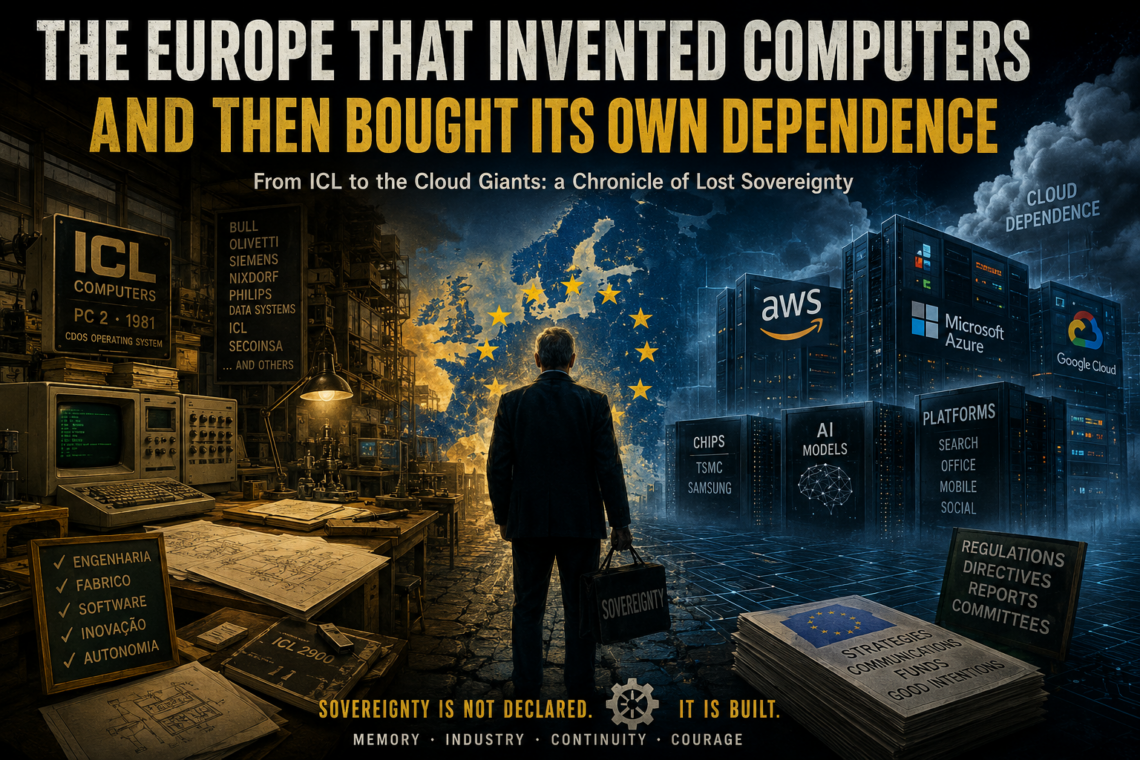
The Europe That Invented Computers and Then Bought Its Own Dependency
FACT BOX
- On 3 June 2026, the European Commission presented a new technological sovereignty package, including proposals related to chips, cloud, AI and open-source.
- Europe once had a relevant computer industry of its own, with companies such as ICL, Bull, Olivetti, Siemens/Nixdorf, Philips Data Systems and others.
- In the 1970s and 1980s, Europe produced hardware, operating systems, system software, business applications and industrial technical knowledge.
- Over recent decades, Europe has lost much of that capacity and has become heavily dependent on North American and Asian platforms.
- Projects such as Quaero, LiMux and Gaia-X reveal a recurring European pattern: announce sovereignty, fund pilots, lose continuity and return to dependency.
The Europe That Invented Computers and Then Bought Its Own Dependency
From time to time, Europe wakes up startled and discovers that it is technologically dependent on the United States, on Asia, on the great digital platforms and on the giants that build the invisible infrastructure of the modern world. It wakes up, holds conferences, publishes communications, convenes panels, produces reports, creates programmes, announces funds and solemnly declares that the hour of technological sovereignty has arrived.
Then the day passes.
The institutional late afternoon arrives, the lights in the conference room are switched off, the glasses of water are collected, the PowerPoint presentations are archived, and Europe returns to its usual comfort: Microsoft in the office, Amazon or Azure in the cloud, Google in search, Apple or Android in the pocket, Nvidia in artificial intelligence, TSMC and Samsung in semiconductors, and the great continental hope wrapped in regulations, directives and good intentions.
The tragedy is not that Europe does not know how to think. The tragedy is that it thinks too much after it has already stopped manufacturing.
The New Awakening of 2026
In June 2026, the European Commission once again presented a technological sovereignty initiative, seeking to reduce Europe’s dependence on foreign suppliers in critical areas such as semiconductors, cloud, data centres, artificial intelligence and open-source software. Among the announced proposals are the Chips Act 2.0, the Cloud and AI Development Act and a new European open-source strategy.
According to the European Commission itself, this package aims to strengthen Europe’s technological capacity and support safer, more competitive and more resilient digital ecosystems. Reuters described the initiative as an attempt to curb European dependence on major North American technology companies, especially in sensitive sectors such as banking, energy, healthcare and public administration. The Associated Press also underlined that the European Union is seeking to reduce its dependence on the United States in cloud and AI, and on Asia in microchip production.
All this is necessary. But the uncomfortable question remains standing, hands in pockets, with an ironic smile:
Why is Europe always restarting what it should never have abandoned?
The Europe That Knew How to Build Machines
There was once a Europe that manufactured computers. Not merely metal boxes with blinking lights and patriotic logos, but complete systems: hardware, operating systems, compilers, languages, databases, communications, business applications, technical support, training and research.
The Europe of the 1970s and 1980s had companies such as Bull, Olivetti, ICL Computers, Siemens/Nixdorf, Philips Data Systems, Secoinsa and others. They were imperfect companies, naturally. They had limitations, fragmented markets, political dependencies and difficulties of scale. But they had one thing that is now missing like bread in an isolated village: a real capacity for technological construction.
ICL, in the United Kingdom, was not merely a hardware manufacturer. It was a company with systems engineering, proprietary software, research, links to universities, development centres and a significant international presence. The company was born in 1968 from the merger of several British computing entities and became the main symbol of the United Kingdom’s computer industry, until it was progressively absorbed by Fujitsu and disappeared as an independent entity in 2002.
The ICL 2900 series, the VME operating system, mid-range systems, mainframes, terminals, retail products, banking systems, communications solutions and development environments were all part of a complete ecosystem. Those who lived through that time know it well: there was an industrial intelligence there that did not merely buy technology. It produced it.
Today, much of that memory has disappeared. Not only from factories, but also from universities, ministries, boards of directors and political imagination.
The Great Sweet Surrender
From the 1990s onwards, Europe began to surrender layer by layer. First, it surrendered on the desktop. Then it surrendered on the operating system. Then on office software. Then on search. Then on mobile phones. Then on the cloud. Then on advanced chips. Now it looks at artificial intelligence like someone watching a train that has already departed, wondering whether there might still be a second-class carriage to Brussels.
The surrender was not announced as surrender. It came wrapped in comfortable words: rationalisation, interoperability, modernisation, compatibility, efficiency, standardisation, outsourcing, cost reduction, strategic partnership. The vocabulary was elegant; the result was brutal.
Europe ceased to control its technological base. And when a civilisation ceases to control its technological base, it may continue to write laws about the digital world, but it no longer truly governs the ground beneath its feet.
It is excellent to protect digital rights. It is necessary to regulate platforms. It is indispensable to defend privacy. But no technological civilisation lives on regulations alone. It lives on factories, programmers, systems architects, networks, data centres, patient capital, intelligent public procurement, applied research and industrial courage.
Europe has become brilliant at regulating what it no longer dominates.
Quaero: The European Dream of Competing with Google
In the mid-2000s, Europe experienced another of those solemn awakenings. The Quaero project, launched with strong Franco-German political momentum, aimed to create a kind of European response to Google’s dominance in search and multimedia indexing.
The name was beautiful. Quaero: “I seek.” But Europe sought, and sought, and in the end mostly found internal divergences. Germany withdrew from the project in 2006, strategic differences emerged between a more text-based approach and a more multimedia-oriented one, and the project ultimately became yet another monument to Europe’s inability to turn ambition into a global product.
This pattern repeats itself almost like liturgy:
first, the grand speech;
then, the consortium;
next, the committee;
then, national disagreement;
finally, the report explaining why it was not possible to compete.
It is innovation by minutes of meeting. A technological revolution drafted by lawyers and closed due to lack of strategic alignment.
LiMux: When Freedom Fails for Lack of Continuity
The case of Munich, with the LiMux project, is another powerful symbol. The city attempted to migrate to Linux and free software, seeking strategic independence from proprietary vendors. For years, it was presented as a European example of digital autonomy.
But political continuity failed, internal resistance emerged, support problems appeared, acceptance proved difficult and institutional pressures mounted. The project suffered reversals and reorientations. Later, Munich once again discussed open-source policies, trying to recover lessons from the previous experience.
The problem was not merely Linux. It was the absence of doctrine. Technological sovereignty is not installing Linux over an administrative weekend. It is training people, maintaining teams, guaranteeing support, funding continuity, adapting processes, building an ecosystem and resisting the comfortable nostalgia of the dominant supplier.
Free software does not fail because it is free. It fails when it is treated as a budgetary eccentricity rather than as strategic infrastructure.
Gaia-X and the Cloud That Never Quite Became a Cloud
In cloud computing, Europe woke up late. When AWS, Azure and Google Cloud already had planetary scale, colossal investment, mature ecosystems and market dominance, Europe began speaking of sovereignty, federation, interoperability and standards.
The Gaia-X project was born with the ambition of strengthening European digital sovereignty through a federated, open infrastructure compatible with European values. The intention was noble. The problem is that a federation of principles does not, by itself, replace an industrial cloud with scale, mature services, commercial capacity, mass adoption and continuous investment.
Europe wanted to respond to hyperscalers with institutional architecture. But hyperscalers are not merely data centres. They are complete ecosystems of computing, storage, networks, security, databases, artificial intelligence, DevOps, marketplaces, certifications, support and business integration.
Once again, Europe confused sovereignty with framework. But sovereignty is not decreed. It is built.
The Silent Virus: Bureaucracy Against Intelligence
Europe’s real enemy is not only competition from the United States, China, Korea, Taiwan or Japan. The deeper enemy lies within Europe itself: the bureaucracy that suffocates intelligence before it can become a product.
The European Union can produce directives, mechanisms, framework programmes, observatories, funds, regulations, committees, expert groups and consultation platforms. But when the time comes to build global companies, dominant systems, simple, fast and competitive products, the long procession of stamps begins.
Administrative mediocrity is particularly skilled at domesticating technical excellence. It takes a brilliant engineer and turns him into a form manager. It takes an industrial idea and turns it into a pilot project. It takes a product and turns it into an application file. It takes a creative team and forces it to explain, in twenty annexes, why it deserves to exist.
Europe does not lack intelligence. It has difficulty allowing it to breathe.
Regulation Is Not Enough
Europe likes to present itself as a normative power. And, in part, that is true. The General Data Protection Regulation, legislation on digital markets, debates on artificial intelligence and the defence of fundamental rights in the digital space are relevant contributions.
But regulation is not replacement. Oversight is not manufacturing. Fining is not innovation. Writing rules about other people’s platforms is not the same as creating platforms of one’s own.
The necessary question is simple:
where are the European operating systems of global scale?
where are the dominant European clouds?
where are the European foundational AI models with planetary adoption?
where are the European manufacturers of mass-market hardware?
where is the public procurement strategy that protects European technology when it is strategic?
Europe cannot continue behaving like a civilisation that writes the moral code of the digital world while importing almost all of its operational code.
What Would Have to Change
European technological sovereignty would require a cultural change, not merely another legislative package. It would require a digital industrial doctrine with continuity over decades, not episodic announcements driven by geopolitical weather.
Europe would have to buy European when critical infrastructure is at stake. It would have to fund companies long enough for them to mature. It would have to use open-source as public infrastructure, not as ideological decoration. It would have to create sovereign clouds with real scale. It would have to support chips, systems, electronics, system software and AI as strategic sectors. It would have to connect universities, companies and the State without turning everything into a bureaucratic swamp.
And, above all, it would have to recover respect for the engineer, the programmer, the systems architect, the applied researcher, the technician who knows how to build and the entrepreneur who takes risks.
There is no technological sovereignty without people capable of building. And there are no people capable of building when everything around them is organised to request authorisation, fill in forms and wait for opinions.
Epilogue: Europe Needs a Workshop, Not Merely an Office
Europe once had a workshop. It had laboratories, factories, teams, mainframes, mid-range systems, research, universities connected to industry, languages, operating systems, proprietary architectures and technical pride.
Then it exchanged the workshop for the office. It exchanged the engineer for the programme manager. It exchanged industrial ambition for the strategic document. It exchanged the factory for the public tender. It exchanged technological memory for comfortable dependency.
Now it wakes up, from time to time, and discovers that the digital house in which it lives was built by others.
Perhaps there is still time. Europe still has extraordinary universities, brilliant scientists, high-quality engineers, niche companies, regulatory capacity, an internal market and a humanist tradition that could give the world a technology more respectful of human freedom.
But for that, it will have to do more than wake up.
It will have to get up.
It will have to drop the pillow of regulations, put on the boots of engineering and return to the workshop.
Because technological sovereignty is not born in communiqués.
It is born where it has always been born: in the courage to build.
References and Consulted Publications
-
European Commission — Strengthening Europe’s tech sovereignty, 3 June 2026.
https://commission.europa.eu/news-and-media/news/strengthening-europes-tech-sovereignty-2026-06-03_en -
European Commission — Communication on European Tech Sovereignty, accompanied by an EU Open Source Strategy, 3 June 2026.
https://digital-strategy.ec.europa.eu/en/library/communication-european-tech-sovereignty-accompanied-eu-open-source-strategy -
Reuters — EU targets Big Tech dependence with ‘made-in-Europe’ drive, 3 June 2026.
https://www.reuters.com/business/eu-targets-big-tech-dependence-with-made-in-europe-drive-2026-06-03/ -
Associated Press — European Union launches tech sovereignty initiative to boost chips, cloud and AI at home, 3 June 2026.
https://apnews.com/article/b16729f7758120260c7005bfba0774c3 -
European Commission — Proposal for the Chips Act 2.0, 2026.
https://digital-strategy.ec.europa.eu/en/library/proposal-chips-act-20 -
European Commission — European Chips Act.
https://digital-strategy.ec.europa.eu/en/policies/european-chips-act -
The Guardian — Germans pull out of European bid to rival Google, 28 December 2006.
https://www.theguardian.com/technology/2006/dec/28/news.germany -
Interoperable Europe / OSOR — Munich’s Long History with Open Source in Public Administration, 31 January 2024.
https://interoperable-europe.ec.europa.eu/collection/open-source-observatory-osor/document/munichs-long-history-open-source-public-administration -
Archives of IT — ICL — International Computers Limited.
https://archivesit.org.uk/icl/ -
Polytechnique Insights — Gaia-X: the bid for a sovereign European cloud, 18 June 2025.
https://www.polytechnique-insights.com/en/columns/digital/gaia-x-the-bid-for-a-sovereign-european-cloud/
Chronicle by Francisco Gonçalves
In Fragmentos do Caos, where lucidity still tries to cross the bureaucratic fog before the machine turns us all into authenticated users of our own decadence.
Editorial Note
This chronicle is born from the living memory of someone who knew and collaborated within a technological Europe that still built, invented, programmed, manufactured and competed. A Europe where companies such as ICL, Bull, Olivetti, Siemens/Nixdorf, Philips Data Systems and so many others showed that the continent was not condemned to be merely a consumer of other people’s technology.
The text does not seek to deny Europe’s progress in regulation, digital rights, privacy or scientific research. On the contrary: it recognises them. But it seeks to underline an uncomfortable truth — a civilisation that regulates what it no longer manufactures risks confusing sovereignty with headed paper.
The criticism expressed here is not against Europe as an idea. It is against its industrial surrender, against the bureaucracy that suffocates intelligence, against the inability to transform talent into global products, against the ease with which strategies are announced and paths are abandoned.
Europe does not merely need more funds, more committees or more communiqués. It needs to recover the workshop, the laboratory, the factory, the code, the risk, the continuity and the respect for those who know how to build.
Because technological autonomy is not proclaimed in Brussels. It is built every day, line by line, machine by machine, idea by idea — before the next generation discovers that it has inherited only regulations with which to administer dependencies.
– Francisco Gonçalves
“in” memories of a life.
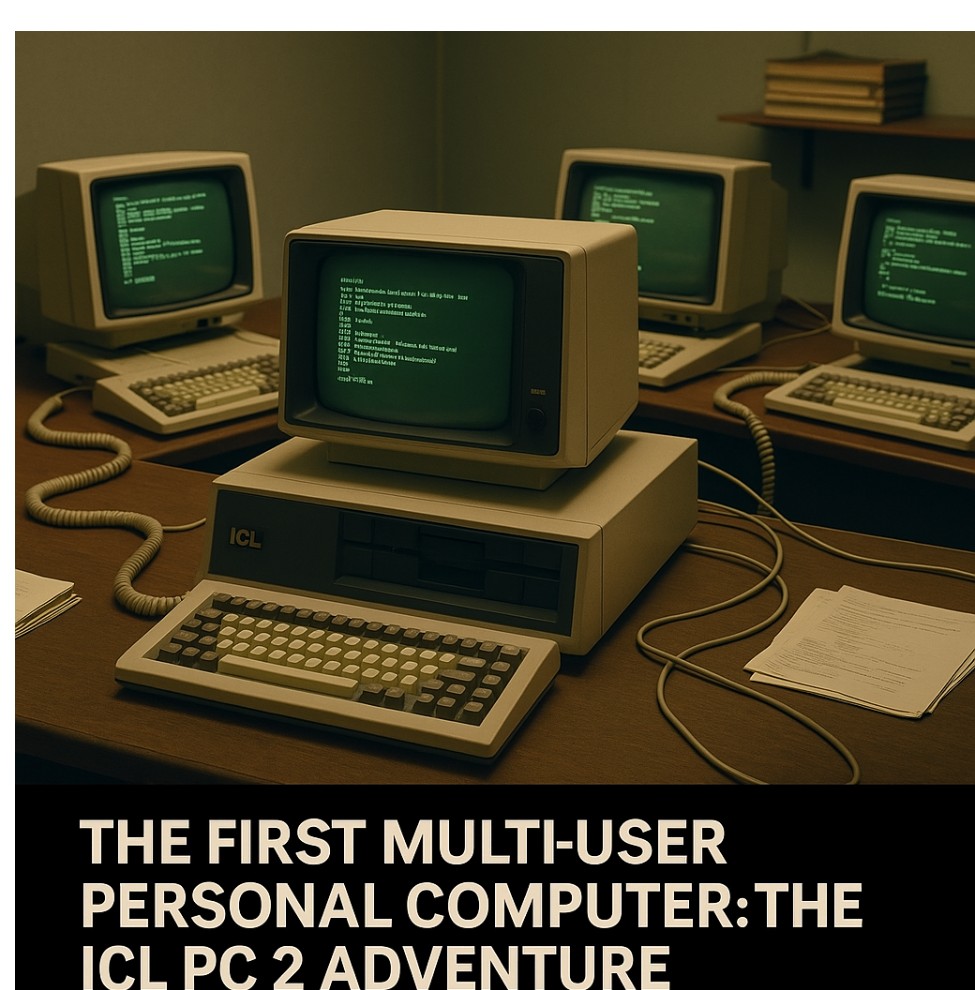
IN THE IMAGE: ICL COMPUTERS PC 2 (1981) CDOS O/S
Europe is not poor in intelligence. It is poor in nerve. It does not lack brains, universities or engineers; it lacks vision, risk, continuity and leadership. It has handed the future to bureaucrats who know how to regulate other people’s technological empires, but no longer know how to build their own.

fgoncalves
Francisco Gonçalves, com mais de 40 anos de experiência em software, telecomunicações e cibersegurança, é um defensor da inovação e do impacto da tecnologia na sociedade. Além da sua actuação empresarial, reflecte sobre política, ciência e cidadania, alertando para os riscos da apatia e da desinformação. No seu blog, incentiva a reflexão e a acção num mundo em constante mudança.


Também poderá gostar

Irão: o Regime do Ódio e a Demonstração de Poder que Alarmou o Mundo
Manifesto Fragmentos do Caos — Pela Palavra Livre e pela Memória Indestrutível