The European Union, the Sermon of Transparency, and the Side Door of Private Interests
Fragmentos do Caos · FC-Chronic-News
The European Union, the Sermon of Transparency, and the Side Door of Private Interests
The EU lectures the world on the rule of law, transparency and democratic values. Then one looks inside its own highest court and finds private interests quietly sitting in the front row.
By Aletheia Veritas · For Fragmentos do Caos
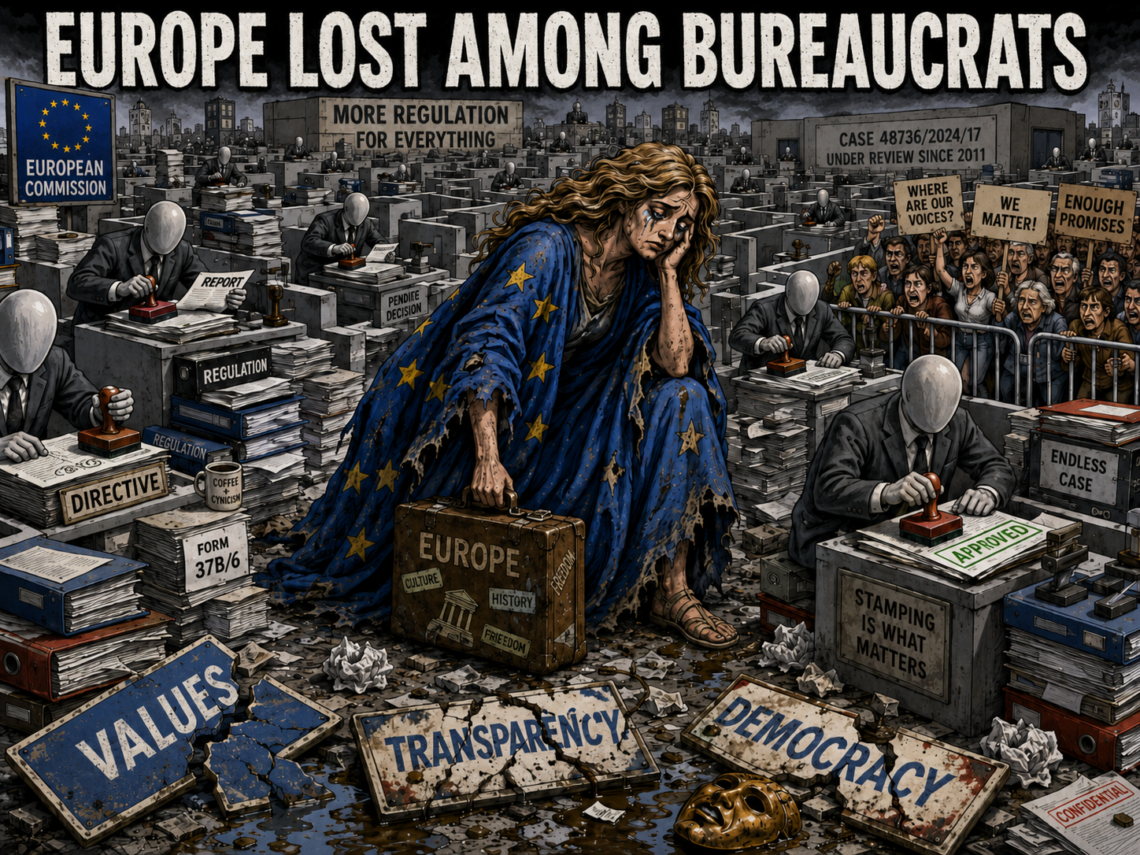
The European Union likes to present itself as the modern temple of the rule of law, transparency, fundamental rights and democratic moral superiority. It is a beautiful image: blue flag, golden stars, carefully drafted speeches, simultaneous translation and a nearly priestly talent for lecturing others. Then comes an investigation into the Court of Justice of the European Union, and suddenly even the altar of European law appears to have private interests seated in the front pew.
According to an investigation by Investigate Europe, more than 40 percent of judges and advocates-general at the Court of Justice of the European Union have declared private financial interests. Those interests include holdings in companies and sectors over which the Court may one day rule.
This does not, by itself, prove corruption. Let us say that clearly, before some guardian of institutional solemnity faints into a procedural memorandum. But in a supreme judicial institution, the question is not only whether illegality has been proven. The question is whether there is visible independence, public trust, sufficient transparency and robust safeguards against actual or perceived conflicts of interest.
And that is where the problem begins.
A court does not live by law alone. It lives by trust.
And trust cannot be decreed in Brussels. It must be earned.
1. The Europe That Preaches to Others and Forgets the Mirror
The European Union demands transparency from Member States. It demands judicial independence. It demands anti-corruption reforms. It demands integrity, accountability, reports, audits, targets, indicators, recovery plans, resilience plans, plans for the plans and, naturally, a committee to monitor the plan for monitoring the plans.
But when we look inside its own institutional architecture, we find grey areas, opaque procedures, incomplete public disclosures and a system of case allocation that raises legitimate questions.
It is always charming when the teacher is caught with crib notes in her own pocket.
The EU cannot demand from national governments what it does not practise impeccably in its own institutions. It cannot speak of the rule of law as if distributing democratic indulgences while accepting shadows around the very court that interprets European law for more than 400 million citizens.
European justice must not merely be independent. It must visibly be independent.
It must not merely be legal. It must be clean.
It must not merely be technically correct. It must be democratically credible.
Because when credibility cracks, everything else follows: trust, authority, legitimacy and public respect.
2. The Problem Is Not Having Money. The Problem Is Judging Worlds Where One Has Interests
Nobody expects judges and advocates-general to live like medieval monks, barefoot and fed on lentils and jurisprudence. The problem is not the existence of assets. The problem is the nature of those assets, their proximity to companies, sectors and cases, and the way those interests are declared, assessed and managed.
If a member of a court that decides on competition, environment, pharmaceuticals, energy, technology, taxation or large corporations has financial interests in related sectors, then there is at least a serious transparency issue.
Even if the person is honest.
Even if no decision was ever influenced.
Even if everything is formally within the rules.
Appearance matters.
Justice is not a private experiment in inner purity. It is a public function. And in a public function of this magnitude, “trust us” is not enough. That phrase has already been used by too many governments, banks, regulators and executives before the bill landed in the taxpayer’s mailbox.
European citizens do not need faith. They need guarantees.
3. Opacity Is Suspicion’s Elegant Cousin
The allocation of cases in a court of this importance cannot look like an internal ritual performed behind velvet curtains. If the Court of Justice of the European Union decides matters affecting states, corporations, citizens, markets and fundamental rights, then the distribution of cases must be transparent, auditable and understandable.
Opacity is comfortable for those inside.
It is poisonous for those outside.
Inside, everything can appear normal: internal rules, old practices, trust among peers, institutional tradition, technical language, specialised procedure. Outside, citizens see something else: legal elites deciding enormous matters through mechanisms they cannot scrutinise.
When a significant number of court members declare private financial interests, opacity is no longer merely an administrative weakness. It becomes fuel for democratic suspicion.
Public trust does not die only when scandal is proven. It also dies when institutions demand obedience without offering transparency.
4. Then They Complain About the Autocrats
The European Union is right to criticise Vladimir Putin and other authoritarian regimes. Putin’s Russia is marked by political repression, control of opposition, propaganda, war and contempt for fundamental freedoms. There is no moral equivalence between an imperfect democracy and an aggressive authoritarian regime.
But there is something European democracies too often forget: autocrats feed on our hypocrisy.
Every time Europe preaches transparency and practises opacity, it gives ammunition to its enemies. Every time it speaks of values while tolerating grey zones within its own machinery, it weakens its own authority. Every time it demands cleanliness from others while keeping dust under its institutional carpets, it opens the door to cynicism.
Putin does not need to be right in order to exploit our failures.
He only needs those failures to exist.
Therefore, the democratic answer cannot be: “they are worse”. That is the moral defence of the mediocre. The answer must be: “we clean our house precisely because we do not want to become like them”.
Democracy is not defended by sermons. It is defended by example.
5. The Court That Judges Europe Must Also Be Judged by Transparency
The Court of Justice of the European Union is one of the most powerful institutions on the continent. It interprets EU law, shapes national policies, influences markets, affects companies, protects rights and defines limits on the power of states.
The greater the power, the greater the transparency must be.
There is no democratic reason to accept vague declarations, opaque allocation of cases or insufficient recusal mechanisms when potential conflicts of interest may arise. It is not enough to say that ethics are provided for. It must be shown that ethics work.
A court of this importance should have:
- complete, clear and updated declarations of interests;
- a public register of recusals and conflicts assessed;
- transparent criteria for the allocation of cases;
- independent verification of declarations;
- strict limits on direct shareholdings in publicly traded companies;
- periodic external audits;
- clear sanctions for omissions, misleading declarations or undeclared conflicts.
This is not radicalism. It is institutional hygiene.
And frankly, if a small business owner must declare everything, if a worker is crushed by tax obligations, if a citizen must meet deadlines and prove administrative innocence before blind machines, then perhaps the highest guardians of European law can survive the civilisational trauma of real transparency.
6. European Democracy Cannot Be a Display Window
Europe likes to speak of democracy as if it were an inherited jewel. But democracy is not a museum piece. It is a daily practice. Either it is exercised, verified, corrected and renewed, or it slowly decays, politely and on letterhead paper.
The European danger does not come only from external enemies. It also comes from the internal normalisation of opacity. It comes from silent capture by private interests. It comes from revolving doors between public authority and private influence. It comes from discreet networks that never appear in speeches but often appear in outcomes.
European democracy can die without tanks in the streets.
It can die through closed meetings, inaccessible documents, poorly explained conflicts of interest, technocratic decisions without scrutiny and citizens increasingly convinced that politics and justice belong to private clubs.
It is a less cinematic death.
But very efficient.
Brussels does like efficiency, after all.
7. The Problem With Europe Is Not a Lack of Values. It Is the Distance Between Values and Practice
The European Union has treaties, charters, regulations, directives, courts, ombudsmen, commissions, observatories and reports. It has beautiful words: transparency, integrity, good administration, independence, trust, accountability.
The problem begins when those words start living separately from practice.
- When transparency is an obligation for others, but an inconvenience at home.
- When integrity is a slogan, but not an architecture.
- When trust is demanded from citizens, but not returned with clarity.
- When justice presents itself as supreme, but protects itself behind curtains.
Europe does not need more moral rhetoric.
It needs fewer curtains.
8. Rule of Law Cannot Be a Sermon Reserved for Others
The rule of law is not a slogan to be exported to disobedient Member States, inconvenient neighbours or authoritarian regimes. It is a discipline that must begin at home. If the European Union wants to defend the rule of law in Hungary, Poland, Russia or anywhere else, it must first ensure that its own institutions are beyond serious suspicion.
This does not mean EU institutions are equivalent to authoritarian regimes. They are not. The difference between imperfect democracy and authoritarianism remains essential. But the strength of democracy lies precisely in its capacity to expose, correct and reform itself.
The democratic answer to institutional embarrassment is not denial.
It is repair.
A court that interprets European law cannot behave as if transparency were an optional courtesy. It must behave as if transparency were part of justice itself.
Conclusion: Europe Has Authority Only If It Cleans Its Own House
The investigation into private interests at the Court of Justice of the European Union should not be treated as a footnote. It should be treated as a warning.
The EU wants to be a democratic lighthouse. Very well. Then it must accept the light being turned inward.
It is not enough to condemn corruption in Member States.
It is not enough to criticise authoritarian regimes.
It is not enough to publish reports on the rule of law.
It is not enough to lecture national governments.
It is not enough to wear the robe of virtue.
The European Union must practise what it preaches.
The Europe that wants to defend the rule of law must first prove that the rule of law also rules inside Europe itself.
Otherwise, its moral authority will crack. And when moral authority cracks, it is not only institutions that weaken. It is the European idea itself that begins to fracture.
The European Union will not be destroyed only by the Putins of this world.
It can also be corroded from within by private interests, bureaucratic opacity and elites convinced that democracy is a ceremony citizens are invited to watch in silence.
Everything else is just a sermon with an expenses receipt.
International References and Sources Consulted
-
Investigate Europe — “Top EU judges financial holdings raise troubling questions”, 30 June 2026. Investigation on declared private financial interests among judges and advocates-general at the Court of Justice of the European Union.
https://www.investigate-europe.eu/posts/top-eu-judges-financial-holdings-raise-troubling-questions -
EUobserver — “Top EU judges’ financial holdings raise troubling questions”, 30 June 2026. Publication of the Investigate Europe findings, including details on declared holdings, case-allocation opacity and potential perceived conflicts of interest.
https://euobserver.com/224593/top-eu-judges-financial-holdings-raise-troubling-questions/ -
Court of Justice of the European Union — “Ethical Standards for Members and Staff at the Court of Justice of the European Union”. Official page describing the Code of Conduct, declarations of interests, independence, impartiality and conflict-of-interest rules.
https://curia.europa.eu/site/jcms/qua1_6239/en/ethical-standards-for-members-and-staff-at-the-court-of-justice-of-the-european-union -
European Ombudsman — “European Ombudsman annual report for 2025 shows steep rise in complaints”, 22 April 2026. Official communication highlighting transparency and accountability as the largest category of inquiries in 2025.
https://www.ombudsman.europa.eu/en/news-document/en/224093 -
Reuters — “EU watchdog accuses Commission of lack of transparency in ‘urgent’ proposals”, 27 November 2025. Report on the European Ombudsman’s criticism of rushed legislative proposals and lack of transparency in EU decision-making.
https://www.reuters.com/sustainability/boards-policy-regulation/eu-watchdog-accuses-commission-lack-transparency-urgent-proposals-2025-11-27/ -
Transparency International EU — “EU Court rules no institution is above the law: TI EU reaction”, 10 June 2026. Commentary on EU institutional accountability following a General Court judgment involving the European Public Prosecutor’s Office and the European Court of Auditors.
https://transparency.eu/eu-court-rules-no-institution-is-above-the-law-ti-eu-reaction/ -
European Ombudsman — “Guide on the right of public access to EU documents”, updated guidance on Regulation 1049/2001 and public access to documents held by EU institutions, bodies, offices and agencies.
https://www.ombudsman.europa.eu/en/document/en/163353 -
European Parliament — Report on the annual report on the activities of the European Ombudsman, including references to citizens’ right of access to documents and the need to scrutinise EU decision-making.
https://www.europarl.europa.eu/doceo/document/A-10-2024-0016_EN.html

fgoncalves
Francisco Gonçalves, com mais de 40 anos de experiência em software, telecomunicações e cibersegurança, é um defensor da inovação e do impacto da tecnologia na sociedade. Além da sua actuação empresarial, reflecte sobre política, ciência e cidadania, alertando para os riscos da apatia e da desinformação. No seu blog, incentiva a reflexão e a acção num mundo em constante mudança.

Também poderá gostar
Portugal visto pela OCDE: um país que se habituou a viver aquém
Europa, Islão e Estado Laico: O Perigo Começa Quando a Fé Quer Mandar na Lei