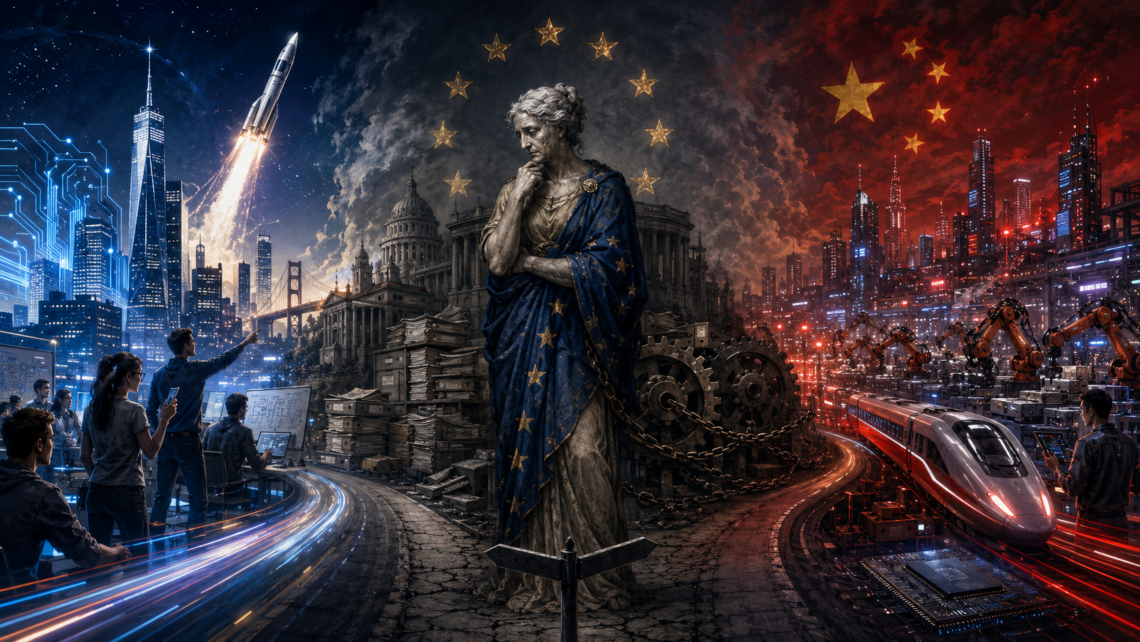
Everything That Can Be Done Will Be Done — With or Without Europe
FACT BOX
- Andy Grove, former CEO of Intel, wrote in Only the Paranoid Survive: “In technology, whatever can be done will be done.”
- The Draghi report on European competitiveness identifies slow productivity, expensive energy, demographic decline and global competition as structural threats to European prosperity.
- The European Investment Bank notes that many innovative European firms face regulatory fragmentation and financing barriers when trying to scale.
- According to the IMF, venture capital investment in the European Union remains far below that of the United States, limiting Europe’s ability to turn research into global technology champions.
- Europe has talent, universities, science, engineering and historical memory. What it too often lacks is the civilisational will to take risks.
The Europe That Got Used to Living Off Rents
When someone says, “It can be done, but it is not always done,” perhaps they are merely describing prudence.
But when one replies, “Everything that can be done will eventually be done by someone,” we are no longer in the realm of opinion. We are in the realm of History.
Andy Grove, former CEO of Intel, summed up better than almost anyone the brutal law of technology:
“In technology, whatever can be done will be done.”
In plain language, without administrative sugar coating: in technology, everything that can be done will eventually be done.
Perhaps not by us. Perhaps not today. Perhaps not in this continent asleep between reports, public funds, conferences, licences, consultations, committees and heavily perfumed caution.
But someone will do it. An American entrepreneur. A Chinese engineer. An Israeli laboratory. A South Korean team. An Indian student with a worn-out laptop, an Internet connection and a hunger for the future that would embarrass many European ministers.
This is where the difference begins. Not in intelligence. Not in talent. Not even in science.
Europe has brains. It has universities. It has laboratories. It has scientific tradition. It has first-class engineers. It has brilliant researchers. It has a history stretching from Galileo to Newton, from Leibniz to Maxwell, from Curie to Einstein, from Turing to Tim Berners-Lee.
Europe was not born small. It made itself small through habit, comfort, fear and a kind of moral fatigue disguised as prudence.
In America, they build. In China, they execute. In Europe, they discuss.
In the United States, Grove’s sentence works like a fire alarm. If something can be done, someone will try. If it fails, they will try again. If it works, they will scale it. If it scales, it will change the market. If it changes the market, it may change the world.
There is brutality in this model, yes. There is inequality, excess, bubbles, arrogance, private empires and concentration of power. But there is also something Europe has partly lost: the conviction that the future is not something to be commented upon — it is something to be built.
In China, the same logic takes another form. It is not the lonely entrepreneur in the mythical Silicon Valley garage. It is the State, industry, capital, universities and national discipline marching together, sometimes oppressively, sometimes with astonishing effectiveness.
China does not spend twenty years asking whether it should build batteries, solar panels, high-speed trains, drones, chips, artificial intelligence or next-generation telecommunications. It decides they are strategic. Then it mobilises resources.
In Europe, with honourable exceptions, the first question is rarely: “How do we build it?”
The question is usually: “Who authorises it? Who regulates it? Who funds it? Who might be offended? Who loses their rents? Who will sue us? Who writes the report? Who creates the committee?”
And so, between idea and execution, a golden swamp appears. It is not lack of intelligence. It is the over-administration of fear.
Europe was not always like this
Let us say it without cheap nostalgia: Europe was not always this meeting room with moral air conditioning.
It was once a continent of risk. It sent ships into unknown seas. It tore open maps. It burned dogmas. It invented instruments, theories, machines, laboratories, universities, the printing press, modern science, industry, calculus, critical philosophy and technical revolutions that transformed the human condition.
There was once a Europe that argued with God, measured the heavens, dismantled atoms, built bridges, electrified cities, created engines, designed computers, practised theoretical physics and raised factories.
That Europe knew that knowledge without application is a library locked in the rain. It knew that science needs industry. That industry needs capital. That capital needs risk. That risk needs character. And that character needs a culture that does not systematically punish those who try.
Then, slowly, Europe got used to rents.
Real-estate rents. Regulatory rents. Financial rents. Positional rents. Rents from protected monopolies. Rents from recurring subsidies. Rents from entrenched sectors. Rents from consulting. Rents from bureaucracy. Rents from political survival.
Rent is the opposite of risk.
Risk asks: “What world can I create?”
Rent asks: “What privilege can I preserve?”
Risk wakes up early.
Rent hires a legal department.
The Draghi report is a late but necessary diagnosis
The Draghi report on European competitiveness stated, in institutional language, what many lucid Europeans had already known for years: Europe is under pressure from weak productivity, high energy costs, demographic ageing and growing global competition.
The report also recognises that Europe can no longer rely on many of the factors that sustained its growth in the past. Translated into workshop language: the old engine is no longer enough to climb the new mountain.
But Europe’s problem is not merely economic. It is spiritual, cultural, civilisational.
Europe has spent too long confusing stability with immobility, protection with blockage, regulation with intelligence, prudence with cowardice and social cohesion with collective anaesthesia.
Of course, regulation is necessary. Civilisation exists partly to prevent the jungle from sitting at the table and ordering dessert.
But when regulation stops protecting citizens and starts protecting incumbents; when it stops organising the market and starts suffocating innovation; when it stops defending the public interest and becomes a wall against new competitors, then we are no longer dealing with civilisation. We are dealing with feudalism with digital forms.
The great disease: turning talent into flight
Europe trains extraordinary people. Then it watches many of its best projects seek capital, scale, markets and ambition outside Europe.
The European Investment Bank has repeatedly pointed to financing difficulties, regulatory fragmentation and scaling barriers affecting innovative European firms.
The IMF has shown that European venture capital investment remains far below that of the United States.
The result is well known: Europe sows research, but too often others harvest the forest.
There is a silent tragedy here.
A European startup is born in Lisbon, Paris, Berlin, Tallinn, Barcelona, Milan or Stockholm. It grows. It needs serious capital. It needs an integrated market. It needs speed. It needs investors who understand technological risk. It needs large contracts. It needs customers who do not first request thirty certificates and an authenticated declaration from the algorithm’s paternal grandmother.
And so it looks to the United States. Or to London. Or to Asia.
Not because it hates Europe. But because Europe loves it like some parents love their children: with so much protection that it ends up breaking their wings.
The rent culture kills the culture of discovery
Societies that live off rents become suspicious of creation.
The new disturbs. The new threatens margins. The new dismantles privileges. The new forces the installed powers to run. And running, as we know, is unpleasant for those who have built their lives sitting on top of a licence, a protected contract, a regulatory barrier or an intimate relationship with power.
That is why Europe talks so much about innovation, but prefers it domesticated, subsidised, audited, presented in PowerPoint and slow enough not to disturb traditional actors.
It wants startups, but not disruption.
It wants artificial intelligence, but fears its own laboratories.
It wants strategic autonomy, but buys American cloud.
It wants semiconductors, but struggles to build complete industrial ecosystems.
It wants technological sovereignty, but continues to behave like a luxury client of other people’s empires.
And then it is surprised.
Surprised that the digital giants are American.
Surprised that strategic manufacturing advances in Asia.
Surprised that China dominates entire industrial chains.
Surprised that the most ambitious young Europeans look elsewhere.
Surprised that productivity does not grow.
Surprised that the continent is ageing not only in years, but in will.
The future does not wait for the prudent
Grove’s sentence should be written at the entrance of every European ministry of economy:
everything that can be done will be done.
The question is by whom.
If Europe does not build sovereign artificial intelligence, someone else will.
If Europe does not build advanced chips at scale, someone else will.
If Europe does not build strategic cloud infrastructure, someone else will.
If Europe does not build technological defence, someone else will.
If Europe does not build industrial biotechnology, someone else will.
If Europe does not build competitive clean energy, someone else will.
If Europe does not build robotics, quantum technologies, satellites, cybersecurity and advanced automation, someone else will.
And then Europe will buy.
It will buy expensively.
It will buy dependently.
It will buy under rules set by others.
It will buy with speeches about European values, while signing contracts for platforms, infrastructures and supply chains it does not control.
There is no sovereignty in PowerPoint.
There is no strategic autonomy in press releases.
There is no future in conferences.
There is a future where there is patient capital, accepted risk, industrial scale, protected talent, reduced bureaucracy, integrated markets, competitive energy, defence of creators and political courage to confront entrenched rents.
Europe’s choice
Europe can still change. But it will not change with slogans. Nor with another decade of diagnoses. Nor with commissioners solemnly discovering that the world did not wait for the next summit.
Europe must once again believe that creating is nobler than administering.
That entrepreneurship is harder than distributing public funds.
That research must lead to production.
That protecting the weak does not mean protecting the mediocre.
That regulating is not the same as suffocating.
That social security without productivity is merely accounting poetry awaiting the demographic invoice.
Above all, Europe must abandon the comfortable illusion that it can remain rich, free, safe and influential while others do what it merely debates.
Because Andy Grove was right.
What can be done will be done.
The question, naked as a blade, is this:
Will it be done by us — or will it be done against us?
Epilogue
Europe was once the workshop of the world, the laboratory of reason, the shipyard of modernity and the burning library of freedom.
But no civilisation can live forever on the interest of its former greatness.
Rents end. Protections rot. Bureaucratic empires age.
And the future, that impatient animal, does not knock twice at the door of peoples who prefer to sleep.
If there is still nerve, let it be used.
If there is still intelligence, let it take risks.
If there is still Europe, let it rise before it definitively passes from author of History to footnote in other people’s reports.
International references
-
Andrew S. Grove, Only the Paranoid Survive, official excerpt published by Penguin Random House Canada:
https://www.penguinrandomhouse.ca/books/72469/only-the-paranoid-survive-by-andrew-grove/excerpt -
European Commission — The Draghi Report on EU Competitiveness:
https://commission.europa.eu/topics/competitiveness/draghi-report_en -
European Investment Bank — Investment Report 2024/2025: Innovation, integration and simplification in Europe:
https://www.eib.org/en/publications/20240354-investment-report-2024 -
European Investment Bank — The scale-up gap: financial market constraints holding back innovative firms in the European Union:
https://www.eib.org/en/publications/online/all/the-scale-up-gap -
International Monetary Fund — Europe Can Better Support Venture Capital to Boost Growth and Productivity:
https://www.imf.org/en/blogs/articles/2024/07/15/europe-can-better-support-venture-capital-to-boost-growth-and-productivity -
Reuters — EU plans tech scale-up fund to narrow gap with US, China:
https://www.reuters.com/world/china/eu-plans-tech-scale-up-fund-narrow-gap-with-us-china-2025-05-28/
Opinion chronicle by
Francisco Gonçalves and Augustus Veritas
because even in chaos, lucid company is useful.

fgoncalves
Francisco Gonçalves, com mais de 40 anos de experiência em software, telecomunicações e cibersegurança, é um defensor da inovação e do impacto da tecnologia na sociedade. Além da sua actuação empresarial, reflecte sobre política, ciência e cidadania, alertando para os riscos da apatia e da desinformação. No seu blog, incentiva a reflexão e a acção num mundo em constante mudança.


Também poderá gostar

Portugal, a Pobreza Bem Distribuída e a Riqueza Bem Guardada

“Sá Fernandes e o Livre… de Memória”