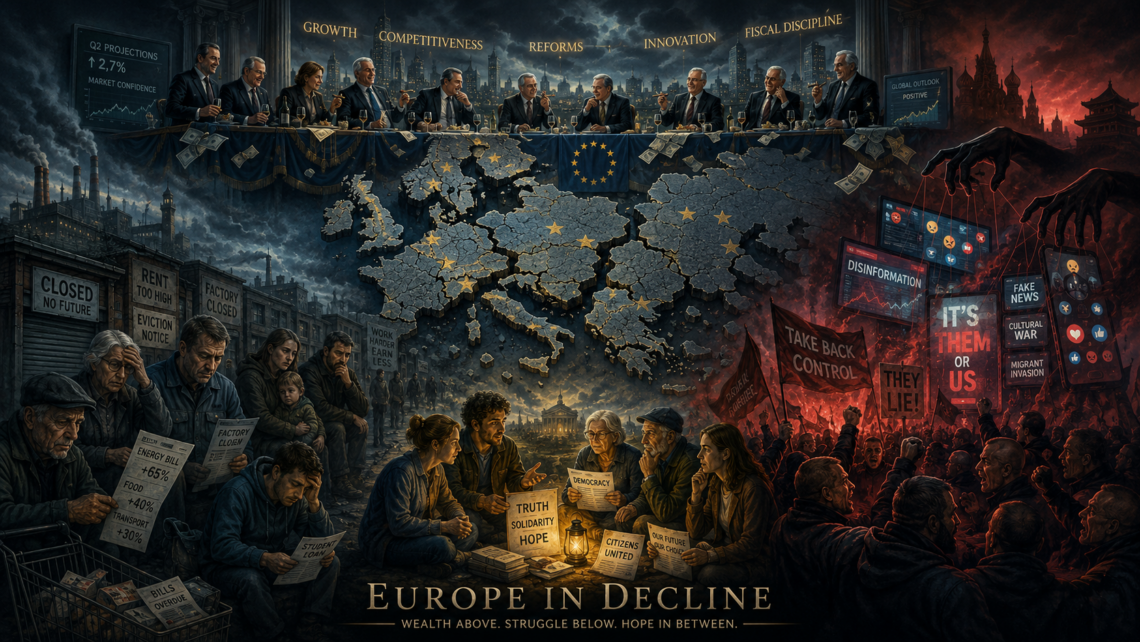
Europe in Decline: Democracies Without Hope, Markets Without Justice and the Advance of Shadows
FACT BOX
- According to Eurostat, the European Union had around 450.4 million inhabitants on 1 January 2025.
- Also according to Eurostat, in 2025 around 92.7 million people in the EU were at risk of poverty or social exclusion, about 20.9% of the population.
- Freedom House reported that global freedom declined for the 20th consecutive year in 2025.
- International IDEA has warned of growing pressure on representation, rights, the rule of law and democratic participation.
- The German Institute for International and Security Affairs estimated that, excluding independents, far-right parties held around 26% of the seats in the European Parliament after the 2024 European elections.
- The European External Action Service identified digital infrastructures used mainly by Russia, but also by China, for foreign information manipulation and interference in the European information space.
- Oxfam reported that billionaire wealth reached 18.3 trillion dollars in 2025, after strong growth since 2020.
- The Draghi Report warned that Europe is losing competitiveness against the United States and China and requires massive additional investment.
Europe in Decline: Democracies Without Hope, Markets Without Justice and the Advance of Shadows
There are historical moments when decline does not arrive with drums, banners or armies on the horizon. It arrives quietly, through scattered signs: exhausted democracies, poorer citizens, young people without homes, elderly people without security, workers without a future, wealth increasingly concentrated, leaders increasingly small, and external enemies increasingly patient.
Europe seems to be living exactly such a moment. A dangerous moment, where decay does not present itself as sudden collapse, but as daily erosion. A democracy losing trust day after day. An economy producing wealth but distributing it ever more poorly. A continent speaking of values while hesitating before force. A Union declaring itself a power, yet too often behaving like a condominium meeting inside a burning building.
The West, and Europe in particular, faces an explosive convergence: democratic deterioration, predatory economics, the relative impoverishment of middle and working classes, obscene wealth concentration, the rise of the far right, external manipulation by Moscow and Beijing, industrial decline, and political leaders unable to speak to their peoples with truth, courage and vision.
This is not merely a crisis. It is a historical antechamber.
Democracy Without Bread Becomes an Empty Ritual
For decades, Europe believed liberal democracy could sustain itself through procedure alone. There were elections, parliaments, courts, a free press, European funds, the single market, the common currency, treaties, summits and statements. It seemed enough. History had ended, some professional optimists claimed, those civil servants of illusion who confuse pause with destiny.
But democracy does not live by procedure alone. It lives on trust. It lives on the deep feeling that institutions protect, that work pays, that children may live better than their parents, that the law applies to everyone, that politics serves the common good, and that voting still changes something.
When this promise breaks, democracy may remain formally standing, but it begins to rot from within.
Freedom House reported that global freedom declined for the 20th consecutive year in 2025. International IDEA has warned of mounting pressure on the core pillars of democracy: representation, rights, the rule of law and participation. These warnings are not academic ornaments. They are sirens. The problem is that Europe, so civilised and polite, seems to have turned sirens into background music.
European democracy is asking for trust from citizens who, in many cases, feel they work more, live worse, pay more, have less security, less housing, less future and less voice. It asks them for moderation while pushing them into precarity. It asks them for civic responsibility while tolerating impunity. It asks them for confidence while allowing political, financial and bureaucratic elites to move between governments, banks, consultancies, regulators and international posts as if the Republic were a private station.
A democracy that does not deliver material dignity eventually becomes a ceremony. People still vote. But they vote with anger.
A Market of 450 Million Means Little if Citizens Grow Poorer
The European Union remains a demographic and economic giant. According to Eurostat, it had around 450.4 million inhabitants on 1 January 2025. It is an immense market, an extraordinary human mass, a regulatory, scientific, cultural and industrial power.
But a large market is not, by itself, a healthy civilisation. A sick elephant remains large. It simply falls with greater noise.
In 2025, according to Eurostat, 92.7 million people in the European Union were at risk of poverty or social exclusion. Around 20.9% of the population. This means that almost one fifth of Europe lives on the edge of the European promise. This is not a statistical margin. It is a continental mass of insecurity, frustration, fear and resentment.
Europe may proclaim values every day. It may illuminate buildings in blue and gold stars. It may print speeches about solidarity, sustainability and inclusion. But if millions of citizens feel that housing has become unreachable, wages do not stretch far enough, energy is costly, healthcare is under strain, justice is slow, children leave and the wealthy inhabit another fiscal planet, then the European project loses flesh. It becomes institutional bone.
And peoples do not defend bones with passion.
The Economy of Predators and the Politics of Resentment
Europe has allowed a poisonous contradiction to grow within itself: it speaks of cohesion while accepting an economy where too many people live under permanent pressure; it speaks of social justice while tolerating colossal fortunes, sophisticated tax avoidance and regulatory capture; it speaks of merit while allowing rents, monopolies, networks and inherited wealth to dominate work, talent and creation.
Wealth concentration is not merely a moral problem. It is a democratic problem. When wealth concentrates excessively, power concentrates as well: media power, influence power, political financing power, legislative power, the power to buy silence, and the power to capture public decision-making.
Oxfam reported that billionaire wealth reached 18.3 trillion dollars in 2025, after strong growth since 2020. The World Inequality Report 2026 again highlighted extreme global wealth concentration. One can debate each methodology, each percentage, each statistical model. Naturally. Humanity invented economists for such rituals. But the trend is too clear to be swept under the carpet: there is brutal accumulation at the top while millions feel themselves descending step by step.
A society where many fall while few accumulate begins to live over political gunpowder.
When democracy does not correct intolerable inequalities, someone will eventually promise to correct them with rage. When the economy does not offer a future, someone will offer enemies. When politics does not deliver justice, someone will sell revenge.
This is how democracies begin to bargain with their own shadow.
The Far Right Grows Where the Centre Fails
The rise of the European far right did not emerge from nowhere. It did not fall from the sky. It is not only the result of ignorance, social media, immigration or Russian manipulation. That explanation would be far too comfortable for the elites: blame the people, blame the algorithms, blame Moscow, and move on to the next state dinner.
The far right grows because it has found fertile soil: inequality, fear, status loss, cultural insecurity, unaffordable housing, poorly managed or poorly explained immigration, slow justice, perceived corruption, arrogant bureaucracy, exhausted traditional parties and a growing sense that democracy has become better at protecting systems than citizens.
The German Institute for International and Security Affairs estimated that, excluding independents, far-right parties held around 26% of the seats in the European Parliament after the 2024 European elections. Reuters reported that nationalist, populist and Eurosceptic parties sought to turn electoral gains into real policy influence within European institutions.
This is no longer folklore. It is institutional power. It is blocking capacity. It is influence over migration, climate, budgets, defence, sanctions, Ukraine, the rule of law and foreign policy.
The error of Europe’s elites was to treat this phenomenon as a passing fever. But fevers pass when the infection is treated. Europe has too often treated only the thermometer.
Moscow and Beijing Have Understood the Weakness
Russia and China do not need to invent all of Europe’s fractures. They only need to exploit them. Internal decline provides the raw material; hybrid warfare provides the amplifier.
Moscow has understood that it can weaken Europe without crossing borders with tanks. It can sow distrust, feed anti-system parties, support anti-European narratives, exploit fears over immigration, war, energy, inflation and cultural decline. It can turn every social crisis into a cognitive weapon.
Beijing plays a longer game: industrial dependencies, critical technologies, value chains, infrastructure, data, platforms, raw materials, economic influence and patient diplomacy. An ancient civilisation does not need to hurry when Europe wastes time on its own.
The European External Action Service has identified digital infrastructures used by foreign actors, mainly Russia but also China, for information manipulation and interference in the European Union and partner countries. Reuters has reported Russian disinformation campaigns targeting European elections, including in Germany, using networks of fake accounts and narratives favourable to forces more sympathetic to Moscow.
Modern war does not need missiles alone. It needs cynicism, bots, manipulated videos, fake pages, bought influencers, useful parties, exhausted citizens and discredited institutions.
Industrialised lies always find fertile ground in societies that have allowed truth to die of bureaucracy.
The Capture of Europe Without a Single Shot
The most dangerous scenario is not only military invasion. It is the political capture of the European Union from within. A divided, paralysed Europe, infiltrated by contradictory interests, dependent on external energy, vulnerable to economic blackmail, socially exhausted and governed by leaders who confuse prudence with fear.
Putin does not necessarily need to defeat Europe on the battlefield. He only needs to help make it ungovernable.
If pro-Russian or Moscow-indulgent parties gain enough strength in national governments, parliaments and European institutions, they can block sanctions, weaken support for Ukraine, divide foreign policy, corrode Atlantic trust and turn the Union into a heavy, contradictory animal unable to act.
Reuters has reported divisions within Europe over contacts with Moscow and recent episodes of resistance or obstruction regarding sanctions against Russia. These episodes reveal the structural vulnerability of a Union that often requires unanimity to act against actors who only need division to win.
Russia plays chess with fear, time and resentment. Europe plays press releases.
The Decay of European Leadership
Europe also suffers from a leadership crisis. Not merely a lack of strong leaders, but a lack of adult leaders. Adult in the rarest sense of the word: capable of telling the truth, bearing costs, preparing the future, confronting vested interests and treating citizens as intelligent people, not as emotional herds to be managed between elections.
Too many European leaders look like managers of damage, not founders of destiny. They react. Adjust. Manage. Negotiate. Delay. Communicate. But rarely transform. European politics has too often become the art of pushing difficult decisions beyond a regional election, an unfavourable poll or an inconvenient summit.
The Draghi Report on European competitiveness was brutal in its message: Europe is losing ground to the United States and China, and needs massive additional investment, industrial coordination, innovation, competitive energy, defence capability and faster decision-making. Reuters summarised Draghi’s warning with an expression that should be written above the entrance of every European institution: do this, or face “slow agony”.
Yet Europe too often remains trapped in ritual: brilliant reports, excellent diagnoses, elegant conferences, urgent conclusions and anaemic execution. A kind of medicine in which the doctor writes superb reports about the disease but is terrified of touching the patient.
The Fatal Error: Replacing the Citizen With the Consumer
Europe’s great error over recent decades was believing that the market could replace citizenship. That the circulation of goods, services, capital and people would be enough. That the European consumer would matter more than the European citizen. That economic integration would automatically produce political integration, belonging, trust and future.
It did not.
A citizen is not merely someone who buys. A citizen is someone who belongs. Participates. Trusts. Hopes. Demands. Accepts sacrifices if there is justice. Defends institutions if those institutions also defend him.
When Europe offers only market, regulation and rhetoric, but fails to offer material security, social mobility, effective justice and hope, it leaves space for those who offer aggressive identity, clear enemies and brutal solutions.
Liberal democracy does not die only when attacked by fascists. It also dies when it becomes indifferent to the concrete lives of citizens. It dies when it locks itself inside technocratic language. It dies when it accepts obscene inequalities as inevitable. It dies when politics becomes career and the economy becomes extraction.
It dies, finally, when it no longer deserves love.
Civilisation Begins to Crumble When the Poor Stop Hoping
There is a difference between poverty and hopelessness. Poverty can be fought when there is a horizon. Hopelessness is more dangerous: it turns the future into an enemy, institutions into lies and anger into identity.
When working poor people stop believing that effort improves life, the ethics of work begin to dissolve. When qualified young people stop believing they will have a home, a family, stability and recognition, the democratic promise loses its heirs. When elderly citizens feel they worked a lifetime only to live in fear, social cohesion breaks. When small business owners feel they sustain bureaucracies, taxes and incompetence that do not respect them, trust disappears.
And when millions live this way, civilisation enters a risk zone.
The far right does not need to convince everyone. It only needs to convince enough people that democracy has already failed, that elites despise them and that freedom is a luxury for those who live protected.
If Europe does not understand this, it will continue to produce its own electoral executioners.
What Can Still Save Europe
Catastrophe is not yet inevitable. Europe still has universities, science, industry, human capital, welfare states, institutions, freedom, cultural heritage, regulatory power, an internal market and a democratic history that must not be handed over to the gravediggers of modernity.
But it needs to wake up. And waking up, here, does not mean another strategy with a brilliant title and sleepy execution. It means rupture.
Europe needs serious reindustrialisation, energy sovereignty, technological sovereignty, real common defence, reduced critical dependencies, investment in science and innovation, affordable housing, taxation less submissive to the ultra-rich, a fierce fight against corruption, fast justice, democratic control of immigration, protection against disinformation, civic education and leaders who speak truth again.
It must also recover the essential pact: those who work must be able to live with dignity; those who obey the law must feel that the law protects them; those who study must have a future; those who create businesses must face less labyrinth and more horizon; those who govern must be accountable; those who become rich through the system must contribute to sustaining it.
Without this, Europe may remain rich, regulated and educated, but politically empty. A beautiful room where nobody believes the host anymore.
Epilogue: Bargaining With Our Own Shadow
The West is not falling only because of its external enemies. It is falling because it allowed a predator economy, mediocre political management, public cynicism and corrosive inequality to grow inside itself.
Moscow and Beijing exploit decline. But much of that decline was produced at home. With ties, MBAs, public office, consultancies, investment banks, foundations, regulators, think tanks and speeches about social innovation. Modern barbarism has learned to use PowerPoint.
Europe will not be defeated only by Russian tanks, Chinese factories or algorithms of disinformation. It will be defeated if it continues to offer its peoples democracies without hope, markets without justice, elites without shame and futures without homes.
When citizens stop believing that freedom improves life, they begin to search for those who promise revenge.
And that is the moment when civilisation begins to bargain with its own shadow.
International References
-
Eurostat — EU population increases for the 4th consecutive year:
Eurostat -
Eurostat — 20.9% of people at risk of poverty or social exclusion:
Eurostat -
Freedom House — Global Freedom Declined for 20th Consecutive Year in 2025:
Freedom House -
International IDEA — The Global State of Democracy 2025:
International IDEA -
SWP Berlin — The Creeping Integration of Far-right Parties in Europe:
SWP Berlin -
Reuters — Europe’s far right seeks policy influence to match seat gains:
Reuters -
Reuters — Russian disinformation targets German election campaign:
Reuters -
EEAS — 3rd Report on Foreign Information Manipulation and Interference Threats:
European External Action Service -
Reuters — Some EU leaders caution against talks with Russia:
Reuters -
Reuters — Bulgaria will veto new EU sanctions package against Russia:
Reuters -
Oxfam — Global Inequality Report 2026:
Oxfam -
World Inequality Report 2026 — Executive Summary:
World Inequality Lab -
European Commission — The Draghi report on EU competitiveness:
European Commission -
Reuters — Draghi urges EU to catch up rivals or face “slow agony”:
Reuters -
European Commission — Competitiveness Compass:
European Commission
Editorial Note: This article is a warning, not an elegy. Europe can still react, but it will not do so through political cosmetics, press conferences or slogans about resilience. There will only be a European future if democracy once again improves the concrete lives of citizens, if the economy stops functioning as an extraction machine, and if institutions recover courage against internal predators and external enemies.
Critic Essay by :
Francisco Gonçalves
With the editorial support : Augustus Veritas
Editorial Note
This text is less an isolated chronicle and more a study of Europe’s progressive decline. There is a central line running through it that must be underlined: Europe is not only being attacked from the outside; it is being corroded from within.
Moscow and Beijing exploit European weakness, but they did not invent it from scratch. The decline was slowly cooked in our own political, financial and technocratic kitchens, with silver cutlery, impeccable speeches and excellent reports. Modern barbarism also knows how to set the table.
The analysis links economic inequality to democratic erosion, because without that connection we are left with only half the truth. Democracies do not fall only because of propaganda, disinformation or external manipulation. They fall when they stop offering citizens a concrete future.
It also shows that the far right grows where the centre fails. It does not excuse it, but it explains the soil in which it germinates. And to understand is not to absolve: it is to prevent stupidity from marching, triumphant, in a new uniform.
Russian and Chinese hybrid warfare appears here as an amplifier of internal fractures. Putin does not need to conquer Brussels with tanks if he can make Europe divide itself, paralyse itself and hand over the keys out of exhaustion, fear or resentment.
When citizens stop believing that freedom improves life, they begin to look for those who promise them revenge.
This may be the harshest summary of the Western crisis. Freedom without material dignity begins to look like an abstraction. Democracy without justice begins to look like theatre. And the market without humanity begins to produce electoral monsters.
It is a hard text, but a necessary one. Europe needs fewer institutional sleeping pills and more moral alarm clocks. It must once again deserve the trust of its peoples before those peoples hand the future to those who offer them rage instead of hope.
– Francisco Gonçalves (2026)
Author’s note: This critical essay was developed with the editorial support of AI, used as an auxiliary tool for structure, language correction and analytical articulation, while preserving the author’s critical perspective and civic intent.

fgoncalves
Francisco Gonçalves, com mais de 40 anos de experiência em software, telecomunicações e cibersegurança, é um defensor da inovação e do impacto da tecnologia na sociedade. Além da sua actuação empresarial, reflecte sobre política, ciência e cidadania, alertando para os riscos da apatia e da desinformação. No seu blog, incentiva a reflexão e a acção num mundo em constante mudança.